Still wrestling with spreadsheets or feeling boxed in by a bookkeeping tool that was fine a year ago but now slows everything down? Choosing the best accounting software in the UK matters because cash flow, VAT, reporting, and day-to-day operations all depend on it. This guide cuts through the usual feature dumping and focuses on what works for UK businesses in 2026, from simple tools for sole traders to ERP options for firms that have outgrown standalone finance apps.
The wider market is moving fast. The UK small business accounting software market is projected to reach about USD 1.05 billion in 2026 and grow at a CAGR of 12.5% between 2026 and 2033, according to Fortune Business Insights' accounting software market outlook. That growth makes sense. More firms want cloud access, real-time data, and fewer manual handoffs.
For many buyers, the hard part isn't finding software. It's knowing when a simple bookkeeping tool is enough, and when it's time to move to something broader. If you're comparing essential accounting tools for UK businesses, start with the stage your business is in, not the one a vendor wants to sell you.
Table of Contents
1. Category 1 Best for Sole Traders & Micro-Businesses

If you're a freelancer, landlord, contractor, or a very small limited company, simplicity matters more than breadth. You need invoices, expenses, bank feeds, VAT support where relevant, and a screen layout that doesn't make basic bookkeeping feel like ERP training.
In this category, FreeAgent, Pandle, and QuickFile are usually the names worth shortlisting first. They suit businesses with straightforward sales cycles and limited operational complexity. If you don't hold stock, don't run manufacturing, and don't need deep departmental reporting, these tools can be enough for a long time.
What tends to work here
- Fast setup: You can usually start invoicing and reconciling quickly without a heavy implementation.
- Low admin overhead: These systems are aimed at owners who aren't accountants.
- Cleaner transition path: If you're still choosing your first proper system, this stage often comes before a wider ERP decision such as choosing an ERP for small business in the UK.
Small firms usually overbuy first and under-integrate later. Start simple if the business is simple.
The trade-off is ceiling, not quality. Basic tools are great until stock, jobs, projects, or multi-channel selling enter the picture. That's where the impact of accounting software choices on growing businesses becomes obvious.
2. FreeAgent

FreeAgent fits people who want UK-focused bookkeeping without a lot of setup friction. It has strong appeal for freelancers, contractors, landlords, and micro companies that need to stay on top of invoicing, expenses, and VAT submissions without learning finance jargon first.
Its interface is one of the easier ones to hand to a non-accountant. That's a bigger advantage than it sounds. Software only helps if the owner uses it every week.
Where FreeAgent is strongest
- Core UK bookkeeping: Bank feeds, invoicing, expense tracking, and MTD for VAT support.
- Approachable workflow: Screens are clearer than many larger platforms.
- Useful for owner-managed firms: Especially where the finance process is still light-touch.
The limits show up when operations get broader. Inventory-heavy businesses, multi-entity groups, and firms with more complicated reporting needs usually hit those limits sooner than expected.
Practical rule: If stock, manufacturing, or consolidated reporting are on your roadmap, don't choose a tool only because it feels easy today.
You can review the platform directly on FreeAgent's website. For a small service business, it's often a sensible fit. For an operational SME, it's usually a stepping stone rather than a long-term system.
3. Pandle
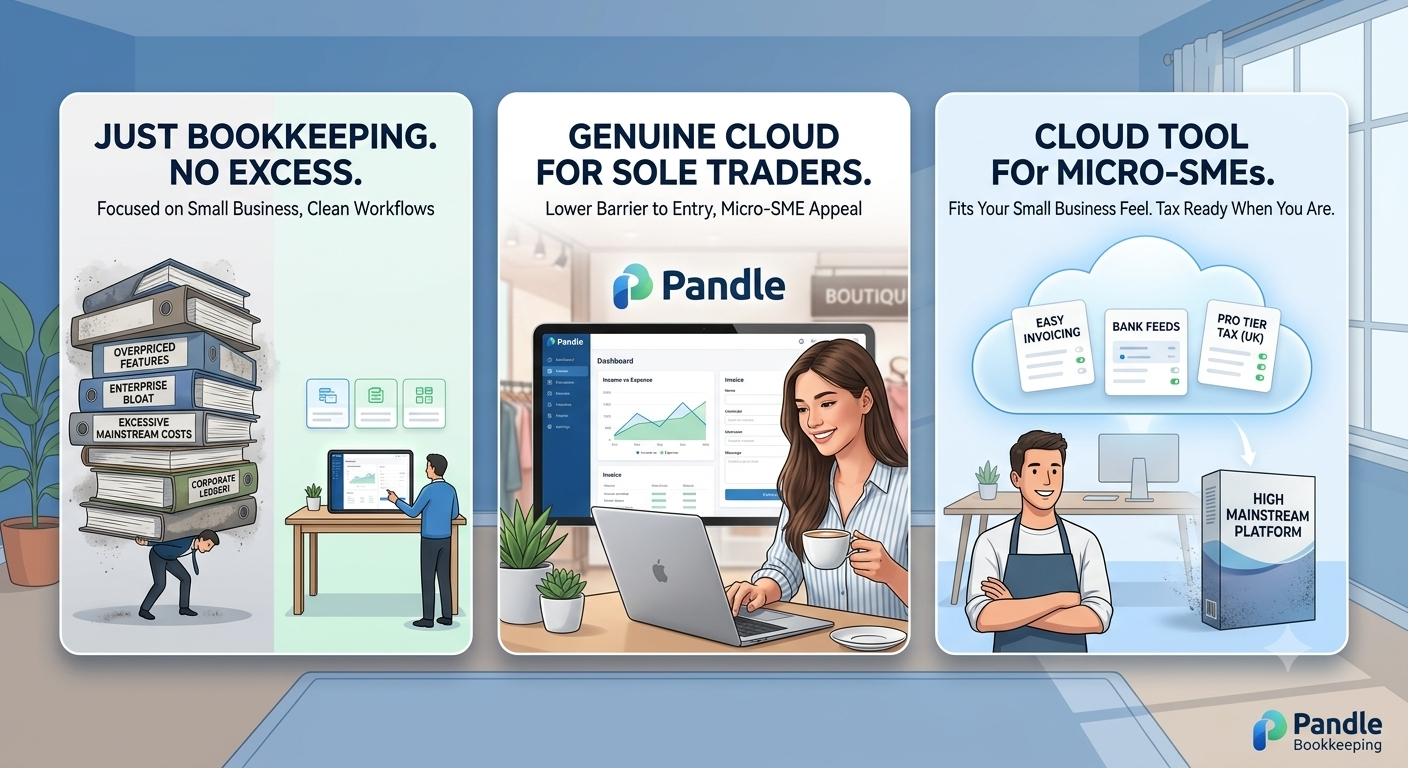
Pandle has a practical appeal. It doesn't try to look like a finance suite for every scenario. It focuses on small-business bookkeeping, clean workflows, and a lower barrier to entry than many mainstream platforms.
That's why it often works well for sole traders and micro-SMEs that want a genuine cloud tool without paying for features they'll never use. The Pro tier adds the tax functionality many UK businesses will eventually need, but the product still keeps a small-business feel.
Why people choose it
- Straightforward bookkeeping: Invoicing, bank feeds, projects, mileage, and VAT tools.
- Clear upgrade path: Businesses can start lean and add more capability later.
- Good fit for simple records: Especially if the team is one person or very small.
Where it falls short is breadth. If you want a wide app marketplace, deeper automation, or strong operational integration, Pandle isn't the strongest option.
A lot of best accounting software UK lists skip an uncomfortable truth. Some SMEs in manufacturing, retail, and logistics don't just need bookkeeping. They need inventory, MRP, and real-time cost visibility. One source argues that this gap is routinely ignored, noting that spreadsheet reliance remains a major issue for those sectors. Pandle isn't trying to solve that problem, and that's fine, as long as you know it.
Check the product at Pandle's website.
4. QuickFile

QuickFile has kept a loyal place in the UK market because it gives very small businesses flexibility. Some users want full bookkeeping in one place. Others want a bridge from existing spreadsheet habits into MTD-ready filing. QuickFile handles both use cases better than many polished-looking rivals.
That makes it a good option for landlords, sole traders, and low-volume businesses that care more about practical function than glossy design. The interface isn't the most refined in this list, but plenty of owners accept that trade if the workflow suits them.
Best fit in practice
- Spreadsheet-to-software transition: Helpful for firms not ready to rebuild everything at once.
- Basic bookkeeping needs: Invoicing, reporting, VAT, and MTD-oriented workflows.
- Cost-sensitive micro businesses: Especially where transaction volumes are still modest.
The downside is that automation and connected banking features may require paid options, and the overall product feels less modern than bigger brands. For some firms, that's no issue. For others, it's the reason they move on later.
Visit QuickFile's website to see whether the bridging approach suits your setup.
5. Category 2 Best All-Rounders for Growing UK SMEs
Once a business moves past basic bookkeeping, the shortlist usually changes. You start caring less about the cheapest way to file VAT and more about reporting, multi-user workflows, approvals, integrations, and whether your accountant already works inside the system.
This is the space where Xero, QuickBooks Online, and Sage Accounting dominate most conversations. They're the standard all-rounders for UK SMEs because they cover the core accounting job well and connect to broader app ecosystems.
What separates this group
- Stronger reporting: Better visibility for management accounts, cash position, and finance controls.
- Better accountant alignment: Your external accountant or bookkeeper has probably used at least one of them extensively.
- Room to grow: They support a longer phase of business maturity than micro-business tools.
As of 2025, about 70% of UK businesses use some form of tax accounting software, and the UK tax accounting software market is projected to grow from USD 1,161.84 million to USD 2,586.1 million by 2035 at a CAGR of 8.33%, according to Market Research Future's UK tax accounting software outlook. That level of adoption tells you these platforms aren't optional background tools anymore. They're central to compliance and finance operations.
For firms that are tightening planning discipline, cash flow forecasting for UK SMEs with Odoo is often the next conversation once the books themselves are under control.
6. Xero UK
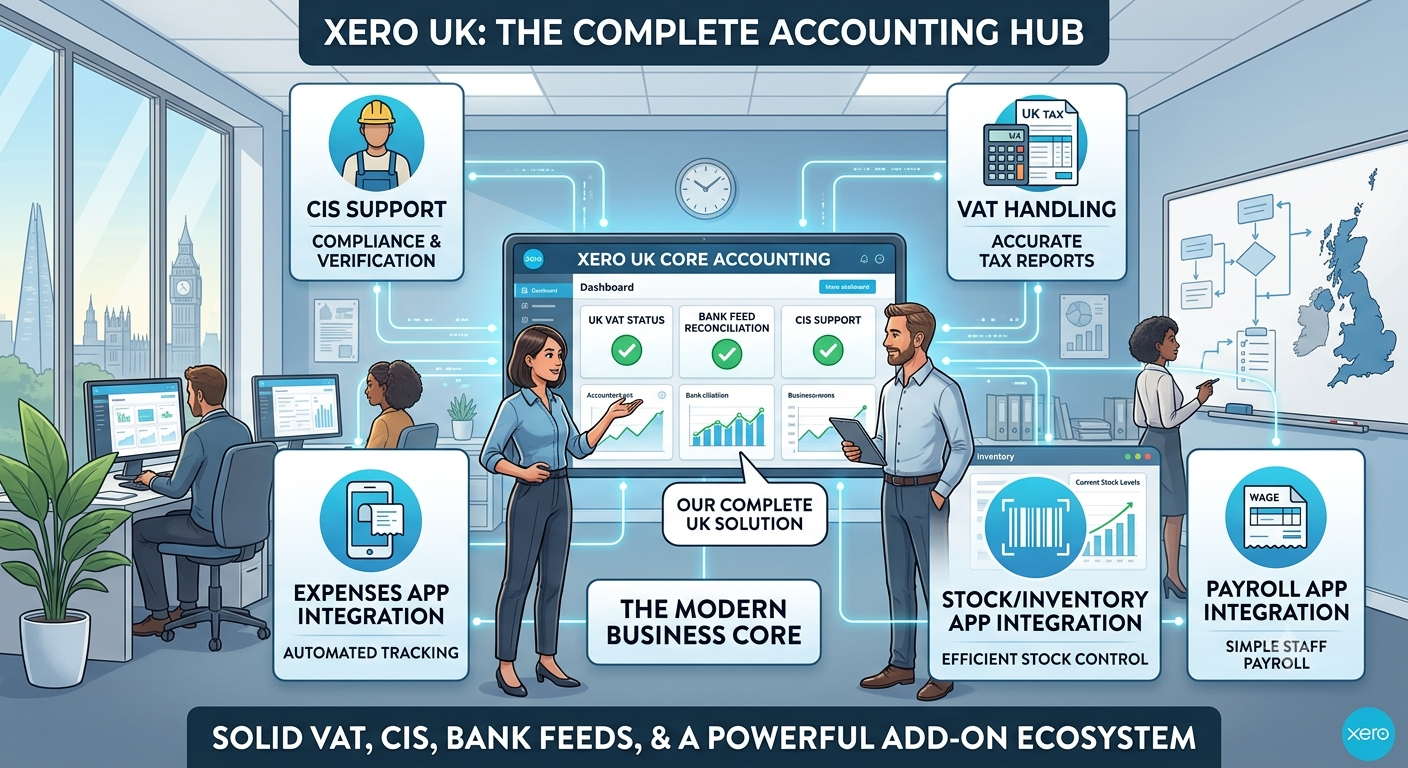
Xero is the default recommendation from many UK accountants, and that isn't accidental. It has broad UK support, good bank-feed workflows, solid VAT handling, CIS support for relevant businesses, and one of the biggest add-on ecosystems in this market.
That ecosystem matters. Xero is rarely the whole system. It's often the accounting core inside a wider stack of apps for expenses, stock, reporting, ecommerce, and payroll.
Where Xero wins
A UK-focused source says Xero holds about 60% of the UK accounting software market and highlights native support for HMRC's Making Tax Digital plus integrations with more than 1,000 third-party apps, as described in this overview of UK bookkeeping software market positioning. In practice, that means it's easy to find accountants, bookkeepers, and integration partners who already know the platform.
It also means businesses can bolt on tools quickly. That's both a strength and a weakness.
The trade-off most buyers learn later
- Strong marketplace: You can extend the system in many directions.
- Good accountant familiarity: Advisory and bookkeeping support is easy to source.
- Rising total cost risk: Add-ons pile up fast, especially when stock or workflow gaps appear.
Xero is strong as an accounting platform. It gets weaker when businesses expect it to behave like an ERP without the ERP structure underneath.
You can explore it at Xero UK. If you need a robust all-rounder and your operations are still manageable through integrations, Xero is a safe choice.
7. QuickBooks Online UK
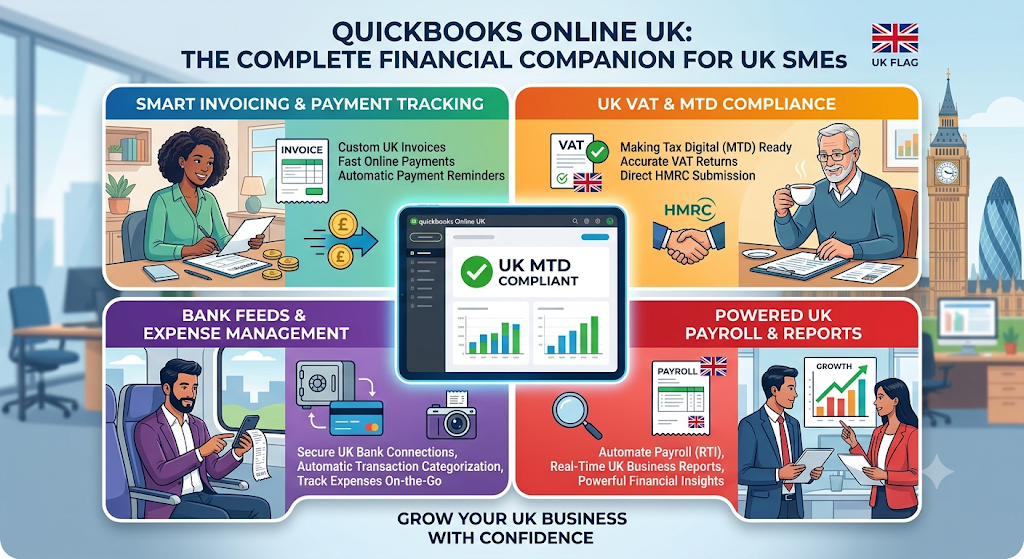
QuickBooks Online UK sits in a very practical middle ground. It gives small and mid-sized firms a familiar interface, core VAT functionality, invoicing, estimates, optional payroll, and enough automation to make everyday finance work smoother without turning setup into a project.
For many teams, a key selling point is familiarity. Plenty of bookkeepers already know it, and users often find the layout easier to grasp than heavier finance systems.
Market position and suitability
One cited market summary estimates QuickBooks at about 25% of the UK small business accounting software market and describes the wider segment as moving toward cloud platforms with API compatibility and integrated tax handling, as noted in this UK accounting software market share discussion. That's useful context because QuickBooks is often chosen by firms that want modern cloud accounting without committing to a broader ERP immediately.
It works well when finance is the centre of the requirement. It works less well when finance has to coordinate tightly with warehousing, production, subscriptions, or complex operational workflows.
Where migration becomes the real issue
Disconnected systems are a recurring pain point in retail and ecommerce. One source claims that many mid-market retailers in England and Wales face reconciliation errors because accounting, ecommerce, POS, and logistics systems don't connect cleanly, and notes that API-first integration questions are still poorly handled in mainstream software guides. That is exactly where firms begin looking at migrating from QuickBooks or legacy ERP to Odoo.
If you're staying in standalone accounting, QuickBooks Online UK is a credible option. If operations are already outgrowing it, the next move isn't another add-on. It's architecture. For teams evaluating both ecosystems, it also helps to learn how to use Xero effectively before comparing migration paths.
8. Sage Accounting Sage Business Cloud Accounting

Sage still carries weight in the UK because it has long-standing trust with accountants, bookkeepers, and businesses that prefer a provider with deep local roots. Sage Accounting isn't the flashiest product here, but it's often chosen by companies that want straightforward VAT workflows and a UK-first compliance posture.
That matters if your priority is less about app experimentation and more about reliable bookkeeping with a familiar vendor. The interface can feel utilitarian, but many finance teams care more about stability than polish.
Where Sage makes sense
- UK-focused workflows: VAT filing and accounting basics are well covered.
- Accountant ecosystem: Advisors and practices are easy to find.
- Steady fit for conventional needs: Particularly for service businesses and straightforward SMEs.
The caution is that industry-specific needs can push you into higher tiers or adjacent Sage products. If your business has stock complexity, heavier operational control requirements, or more bespoke workflows, Sage Accounting may not be the final stop.
Browse the platform at Sage Accounting. It's a sensible choice for firms that want established UK coverage without chasing a broad ERP rollout yet.
9. Category 3 Strong Contenders with Niche Strengths

Not every good option needs to beat Xero or QuickBooks head-on. Some tools win because they fit a specific software stack, pricing expectation, or UK support preference better than the market leaders do.
Zoho Books, KashFlow, and Clear Books belong in that group. They aren't the default recommendation in every buying conversation, but they can be the better choice when the business has a clear niche requirement.
Why these contenders matter
- Suite alignment: Zoho Books works best when the business already uses Zoho apps.
- UK-centric simplicity: KashFlow and Clear Books appeal to firms that want local focus over ecosystem breadth.
- Value positioning: These platforms often make more sense when budgets are tighter or requirements are narrower.
If you're reviewing the best accounting software UK options, this is the section where fit beats popularity. That's especially true if you don't want to pay for a giant app marketplace you'll never use.
10. Zoho Books UK edition
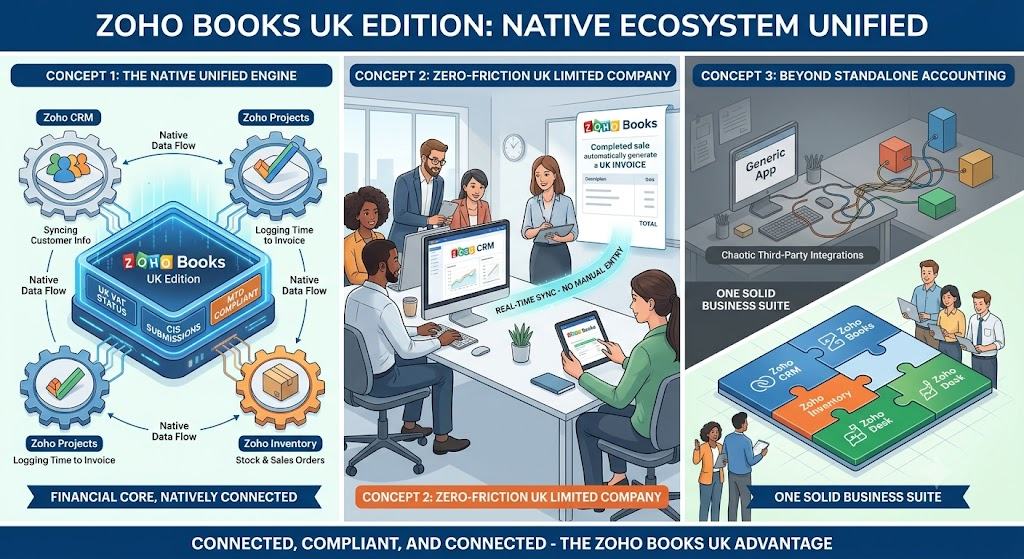
Zoho Books is often underrated in UK comparisons because it gets treated as a smaller accounting product rather than part of a larger business suite. That misses the point. Its value grows when a company also uses Zoho CRM, projects, analytics, or other Zoho applications.
For a business already leaning into that ecosystem, Zoho Books can feel much more connected than a standalone accounting app with a pile of separate integrations.
Best use case
- Businesses in the Zoho stack: The cross-app links are the main draw.
- Cost-conscious teams: The product is often considered affordable relative to larger brands.
- SMEs that want automation without full ERP complexity: It covers a useful middle ground.
The trade-off is that ecosystem depth brings a learning curve. Teams sometimes buy it for simple accounting and then realise the full value only appears when they use more of the suite.
Visit Zoho Books UK if you want accounting software that can sit inside a broader small-business platform without jumping straight to ERP.
11. KashFlow IRIS KashFlow
KashFlow remains relevant because it doesn't overcomplicate the core job. It's aimed at small UK businesses and contractors who want quotes, invoicing, VAT submissions, and basic stock handling in a product that feels local rather than global.
For owners who value UK-based support and a simpler setup path, that's enough reason to keep it on the shortlist. The IRIS connection also gives it some wider ecosystem context, especially for firms already familiar with IRIS-adjacent services.
Where KashFlow fits
- Micro and small businesses: Especially service-led firms with straightforward finance processes.
- UK-first buying preference: Some buyers want local familiarity more than app-store scale.
- Simple operational needs: Quotes-to-invoice workflows are useful and easy to follow.
Its limitation is breadth. The add-on marketplace is smaller than the major cloud leaders, and advanced requirements can arrive quickly if the business starts scaling through new channels or more complex stock handling.
You can review it at KashFlow's website.
12. Clear Books
Clear Books has a similar appeal to KashFlow, but with a slightly different audience feel. It often lands well with small UK businesses and accounting practices that want core bookkeeping, VAT support, local vendor focus, and a simpler interface than some larger platforms.
That simplicity is valuable when the business doesn't need a giant ecosystem. It can also suit firms that prefer dealing with a UK-made product and support model.
What stands out
- Core bookkeeping coverage: Invoicing, expenses, VAT, and bank-feed capability on paid tiers.
- Practice support: Accountants and bookkeepers may value the practice-facing options.
- Reasonable fit for straightforward businesses: Especially if the requirement is solid bookkeeping, not transformation.
The obvious compromise is integration depth. If your roadmap includes ecommerce connectors, deeper workflow automation, or wider business systems, Clear Books can start to feel narrow.
See the product on Clear Books' website. For a local, focused option, it's still worth a look.
13. Category 4 The Integrated ERP Alternative
This is the point most "best accounting software UK" articles skip. Accounting software isn't always the end state. For many SMEs, it's a stage. Once finance has to work in sync with inventory, purchasing, warehouse operations, manufacturing, projects, CRM, and ecommerce, standalone accounting tools start creating more handoffs than they remove.
That's why ERP becomes the next logical step, not an enterprise vanity purchase. It changes the architecture from disconnected apps into one operational system.
When a full ERP becomes sensible
A cited source focused on Odoo argues that its integrated design lets UK SMBs manage accounting, inventory, sales, and manufacturing in a single database, reducing duplicate entry and improving visibility across MRP and finance, as outlined in this explanation of Odoo's integrated SMB approach. That's the practical reason firms move beyond bookkeeping software.
The trigger is usually operational pain. Stock doesn't match accounts. Sales and finance argue over timing. Reporting depends on spreadsheet stitching. At that point, accounting software isn't broken. It's just no longer enough.
If your finance team keeps exporting data just to understand operations, you're already in ERP territory.
For businesses planning that shift, ERP system integration for UK SMEs is the right conversation to have before buying another point solution.
14. Odoo Accounting UK localisation
Odoo Accounting is the strongest option in this list when accounting can't sit in a silo anymore. It's not just a bookkeeping tool. It's the finance layer inside a broader ERP that can also handle sales, inventory, MRP, CRM, ecommerce, projects, and more.
That makes it very different from Xero, QuickBooks, or Sage Accounting. Those tools are usually extended through integrations. Odoo is extended through modules inside the same system.
Why Odoo stands apart
One source states that Odoo Accounting is recognised by HMRC for Making Tax Digital submissions in the UK and supports pre-configured tax rates including 20%, 5%, and 0% exempt, as discussed in this comparison of Odoo and Xero for UK businesses. Another source focused on Odoo 19 says the United Kingdom accounting localisation installs as a native fiscal package that automatically configures the UK sales tax structure, which is shown in this Odoo UK localisation walkthrough.
Those details matter because setup quality determines whether ERP accounting feels powerful or painful. Odoo rewards proper implementation.
Who should choose it
- Growing SMEs with operational complexity: Manufacturing, wholesale, retail, logistics, and multi-channel businesses are the obvious fit.
- Firms outgrowing app stacks: One database is easier to manage than many loosely connected tools.
- Teams that need process design, not just software access: Odoo works best when workflows are mapped properly.
The trade-off is implementation effort. Odoo can do much more, so it needs more thought. Chart of accounts, taxes, inventory logic, user roles, reporting, and integrations should be configured as one design. That's why many finance leaders start with Odoo Accounting for compliance and reporting and then expand into wider ERP modules.
You can explore the platform at Odoo's website.
From Accounting Software to a Unified Business Platform
Choosing software is only the first decision. Getting live cleanly is the second one, and that's where a lot of projects go wrong. Businesses spend weeks comparing dashboards, then rush the migration and end up carrying old chart errors, duplicate contacts, broken opening balances, or half-used features into the new system.
The practical approach is simpler. Clean your legacy data before import. Keep account codes, contacts, tax mappings, and product records under control. Then run the new system in parallel for a short period so finance can check postings, VAT treatment, reports, and bank reconciliations before the old tool is switched off.
Training matters just as much as migration. Good software still fails when teams don't know the daily workflow. Sales people need to understand what creates invoices correctly. Warehouse teams need to understand stock movements if inventory touches finance. Managers need to know which reports they can trust and which custom views still need building.
Many SMEs encounter a significant hurdle. Even the best standalone accounting software can't remove silos between departments if stock lives in one app, CRM in another, ecommerce in another, and reporting in spreadsheets. Finance ends up reconciling the gaps instead of controlling the business.
That is the core argument for ERP, and especially for Odoo. Odoo brings accounting, sales, inventory, purchasing, projects, manufacturing, and operations into one platform. Instead of moving data between systems and hoping it stays aligned, teams work from the same database. That means fewer duplicate entries, better traceability, and cleaner operational reporting.
For UK firms in manufacturing, wholesale, retail, logistics, and other multi-process environments, this shift is often less about adding complexity and more about removing hidden complexity that already exists. The spreadsheets, middleware, manual reconciliations, and patchwork workflows are already expensive. They just don't always show up as one software line item.
ERP Artists works with UK businesses that are at exactly this stage. Some are moving from QuickBooks or Xero because integrations have become brittle. Some are replacing legacy ERP. Others are introducing proper finance and operational controls for the first time. The common thread is the need for a system that reflects how the business runs.
If you're ready to move beyond basic bookkeeping and build a connected operation, Odoo is often the best next step. And if you want that move handled properly, from discovery and process design through migration, training, integration, and support, ERP Artists is built for that job.
If your current accounting setup is doing the books but not connecting the business, ERP Artists can help you design and implement an Odoo solution that fits the way your team works. From migration and custom modules to integrations, training, hosting, and ongoing support, ERP Artists works with UK SMEs and mid-market firms that need more than another accounting app.