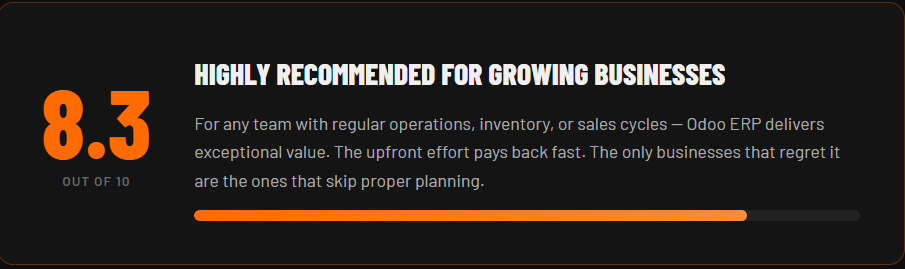
Straight answer first yes, for most growing businesses, Odoo ERP is absolutely worth it. But I am not going to leave it at that, because the real answer depends on your situation. The better question is: worth it for whom, and under what conditions? That is exactly what this review covers. No sugarcoating. No sales pitch. Just an honest look at what Odoo actually costs, what it gives you in return, and whether it makes sense for your business in 2026.
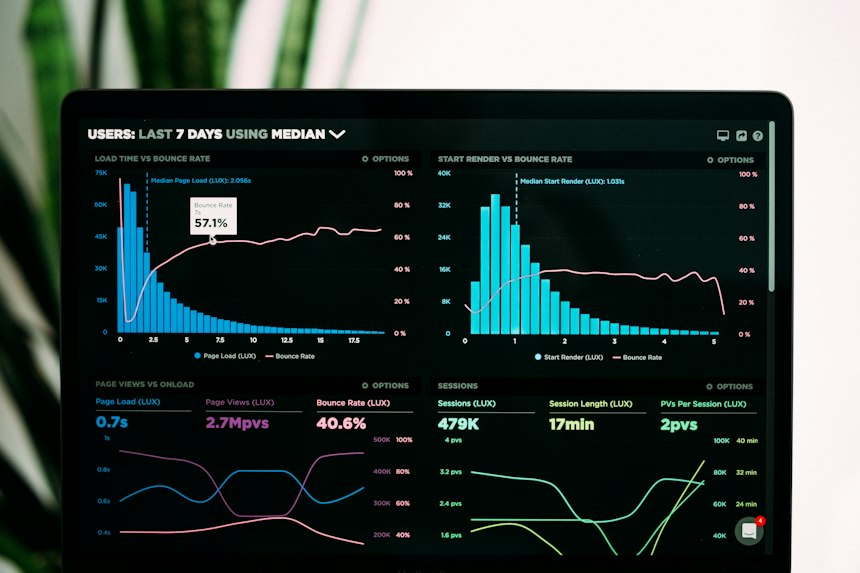
Odoo ERP gives you a live, connected view of your entire business — sales, stock, accounts and more
Let's Talk About the Real Cost First
Before you commit to any software, you want to know what you are getting into. Odoo has two main versions Community and Enterprise. Community is open-source and completely free. Enterprise is paid, and the cost depends on how many users you have and which modules you need.
Implementation cost is what most people forget to budget for. Setting up Odoo properly, migrating your data, and training your team takes real time. If you work with a certified partner expect to invest anywhere from £2,000 to £30,000+ depending on complexity. That sounds like a lot. But compare it to three more years of running broken, disconnected tools and the math usually flips within the first year.
Real Number to Keep In Mind:
Most businesses that switch to Odoo ERP recover their full implementation cost within 6 to 12 months through time saved, errors eliminated, and overlapping subscriptions cancelled.
What You Actually Get For Your Money
When you invest in Odoo, you are not paying for one tool. You are paying for an entire business operating system. One platform that connects your sales pipeline, your warehouse, your accounts, your HR, your projects, and your eCommerce. All in real time. All from one login.
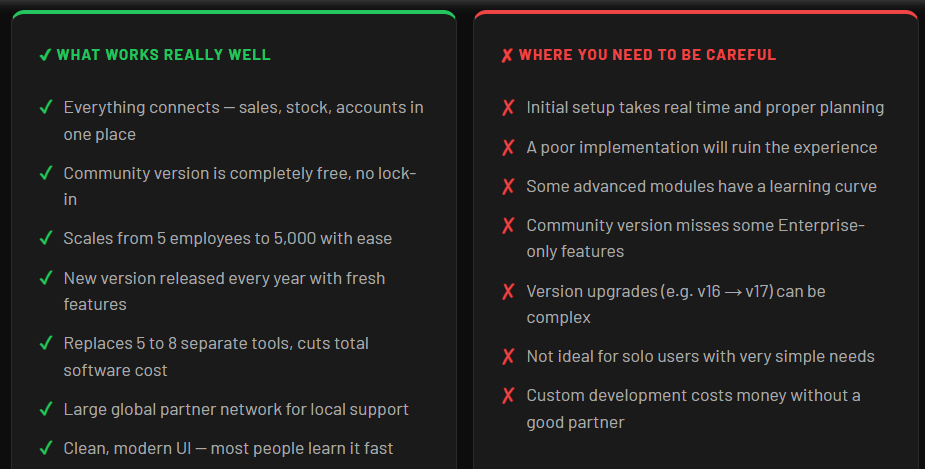
The Honest Pros & Cons
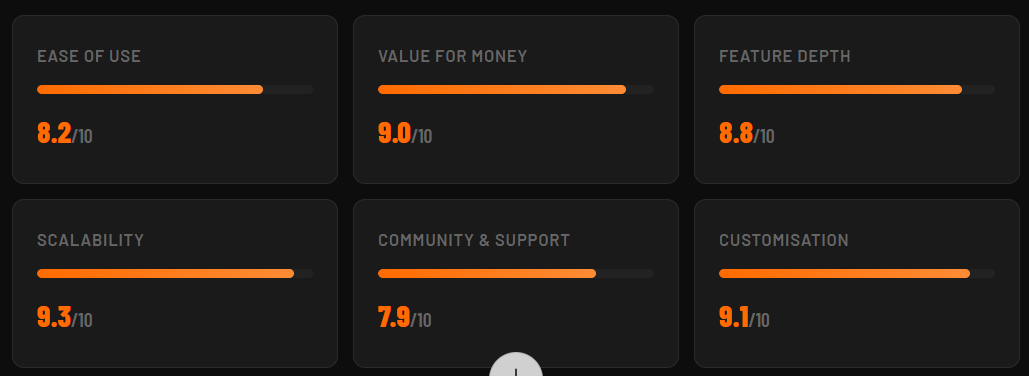
I have seen Odoo work beautifully for businesses. I have also seen it frustrate teams that were not ready for it. Here is the balanced picture.

Real-time dashboards replace the guesswork — every decision backed by live data
Odoo vs The Competition
To put the investment in perspective, here is how Odoo stacks up against the other options businesses typically compare it to.
| What We Compare | Odoo ERP | SAP Business One | Microsoft Dynamics |
|---|---|---|---|
| Starting cost | Free / $11.90/user | ~$3,000+ setup | ~$70/user/month |
| Implementation time | 2 – 12 weeks | 6 – 18 months | 6 – 12 months |
| Best for | SME to Enterprise | Large enterprise only | Mid to large enterprise |
| Customisation | Open-source, very flexible | Limited, expensive | Possible but costly |
| Ease of use | Modern, user-friendly | Complex UI | Familiar but heavy |
| ROI timeline | 6 – 12 months | 18 – 36 months | 12 – 24 months |
The ROI Breakdown — Does the Math Work?
Let us say you currently pay for QuickBooks, a CRM, a project tool, and a separate inventory system. Add those subscriptions up. Now add the hours your team spends copying data between them every week. Multiply that by your average hourly rate.
In most cases, businesses are losing £2,000 to £8,000 per month in hidden inefficiency costs without realising it. Odoo consolidates all of that into one platform. The time saved in accounting, inventory, and sales tracking alone usually pays for the subscription within two to three months. The implementation cost takes a bit longer to recover but it is a one-time investment, not a recurring one.
📊 G2 Reviews 2025–26:
Odoo holds a 4.2 out of 5 rating across 1,800+ verified reviews. The most common thing business owners say? "We wish we had switched sooner."