Most ERP advice starts in the wrong place. It tells finance directors to buy a system that closes the month faster, automates bookkeeping, and produces cleaner reports. Those outcomes matter, but they don't answer the harder question for a UK SME: can the finance team see cash pressure early enough to act?
ERP for finance should connect sales, purchasing, stock, payroll inputs, banking, tax, and reporting to the decisions that protect working capital. Odoo can support that model, but only when the implementation redesigns processes rather than copying spreadsheet habits into a new interface. The system must show what has been ordered, invoiced, approved, collected, committed, and still at risk.
Table of Contents
Understanding ERP for Finance Beyond Basic Bookkeeping
A faster month-end close is a useful result, not a complete business case. Finance directors need to know whether customers are paying on time, whether purchasing commitments are absorbing cash, whether stock is tying up funds, and whether a forecast reflects operational reality. A ledger that records yesterday's transactions but leaves tomorrow's cash position uncertain hasn't solved the central finance problem.
UK ERP adoption has developed from a system associated mainly with larger firms into a much broader finance expectation. The historical ONS series covering 2011 to 2014 tracked ERP usage by business size and noted that estimates before 2014 were based on businesses with 10 or more employees, providing a baseline for the way integrated business information systems first became a meaningful enterprise metric in the UK. The background is discussed in this history of ERP adoption and business efficiency.
The more important shift is practical. A finance team shouldn't have to wait for the warehouse manager to update a spreadsheet, the sales administrator to confirm an order, or the buyer to forward a supplier commitment before it can assess cash exposure. With Odoo, operational events can feed financial records and management views as part of the same workflow.
The cash-flow case for an integrated system
A unified ERP gives finance a connected view of:
- Committed spend: Purchase orders and replenishment decisions reveal liabilities before supplier invoices arrive.
- Expected income: Confirmed sales, delivery status, and customer invoices provide context for collection forecasts.
- Working capital: Stock movements, purchasing terms, customer payment behaviour, and supplier due dates can be considered together.
- Decision speed: Managers can investigate exceptions from shared records instead of reconciling competing spreadsheets.
That doesn't mean Odoo automatically creates an accurate forecast. Forecast quality still depends on disciplined transaction capture, sensible payment terms, reliable bank feeds, and clear ownership of master data. The system makes better forecasting possible because the relevant information sits in connected workflows.
Practical rule: If a finance report can't show the operational event behind a number, it isn't yet a decision tool.
The best ERP design therefore starts with cash questions. Which invoices are likely to be delayed? Which purchases are committed but not essential? Which stock lines are consuming funds without supporting near-term sales? Which entities, currencies, or VAT treatments could distort the group view? Bookkeeping becomes the foundation, not the destination.
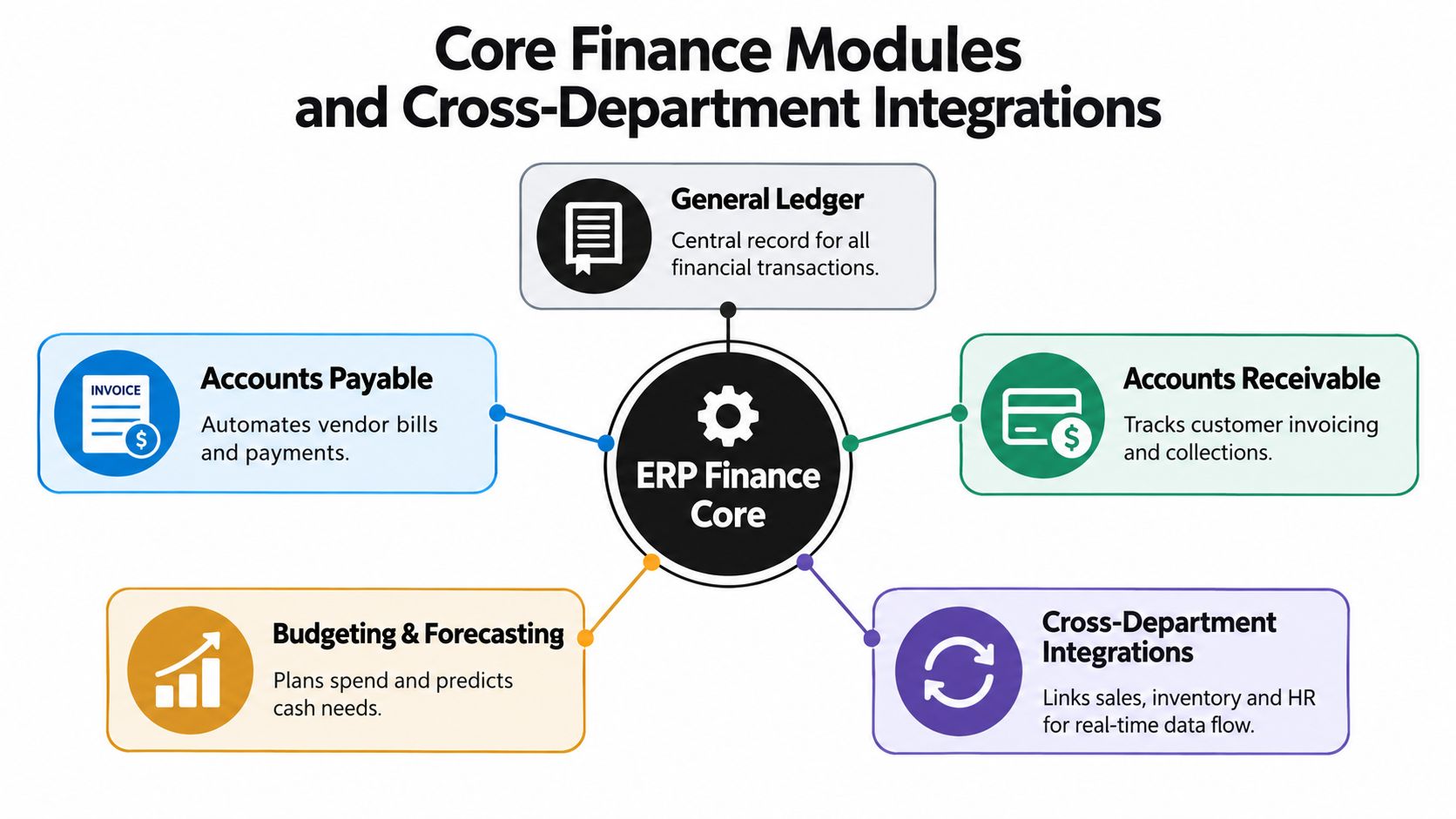
Core Finance Modules and Cross-Department Integrations
A finance database is only as trustworthy as the operational information entering it. Odoo's accounting application can provide the central record, but its value increases when purchasing, sales, inventory, manufacturing, and point of sale use shared products, partners, taxes, currencies, and approval rules.
What belongs in the finance core
The general ledger records financial activity and supports the reporting structure. Accounts payable manages supplier bills, payment preparation, and outstanding obligations. Accounts receivable handles customer invoices, receipts, credit notes, and collection follow-up. Budgeting and forecasting add planned values to actual results, while fixed assets support capitalisation and depreciation processes.
These modules shouldn't operate as isolated menus. A purchase order can begin in procurement, move through receipt and bill matching, and end in the ledger. A customer order can progress through delivery and invoicing, with revenue and stock consequences visible to finance. A point-of-sale transaction can update sales and inventory records without requiring a separate manual journal.
How the data flow affects control
Consider a distributor that sets a replenishment rule for a stocked product. When available quantity reaches the configured threshold, Odoo can create a purchasing action. The finance team can then see the commitment before the supplier bill is posted, provided the workflow and reporting design expose that stage clearly.
The same principle applies to retail. A sale should not exist only in a till report that someone later imports into accounting. Sales, tax, payment method, stock movement, and margin analysis should remain connected. This reduces double entry and gives finance a better explanation for changes in revenue, inventory valuation, and cash receipts.
For businesses reviewing customer-data connections, guidance on how to streamline finance workflows with ERP CRM is useful because CRM ownership, order status, credit information, and invoicing often affect the same cash cycle.
Integration choices that deserve scrutiny
Not every integration belongs in the core system. Keep the Odoo data model authoritative for finance, products, customers, suppliers, taxes, and transaction status. Use APIs or controlled connectors where specialist platforms remain necessary, and define which system owns each field.
Common integration points include:
- Inventory and warehouse: Receipts, deliveries, adjustments, and valuation inputs.
- Manufacturing: Bills of materials, work orders, production consumption, and finished goods.
- Sales and CRM: Quotations, orders, customer terms, renewals, and collection context.
- Point of sale and ecommerce: Transactions, refunds, payment channels, and stock changes.
- Banking and payment services: Statements, matching rules, and reconciliation evidence.
A broader review of Odoo ERP modules for growing businesses can help teams assess which operational applications should sit inside the same platform. The design decision should follow transaction ownership and control requirements, not a desire to activate every available module.
Measuring ROI and Cash Flow Improvements
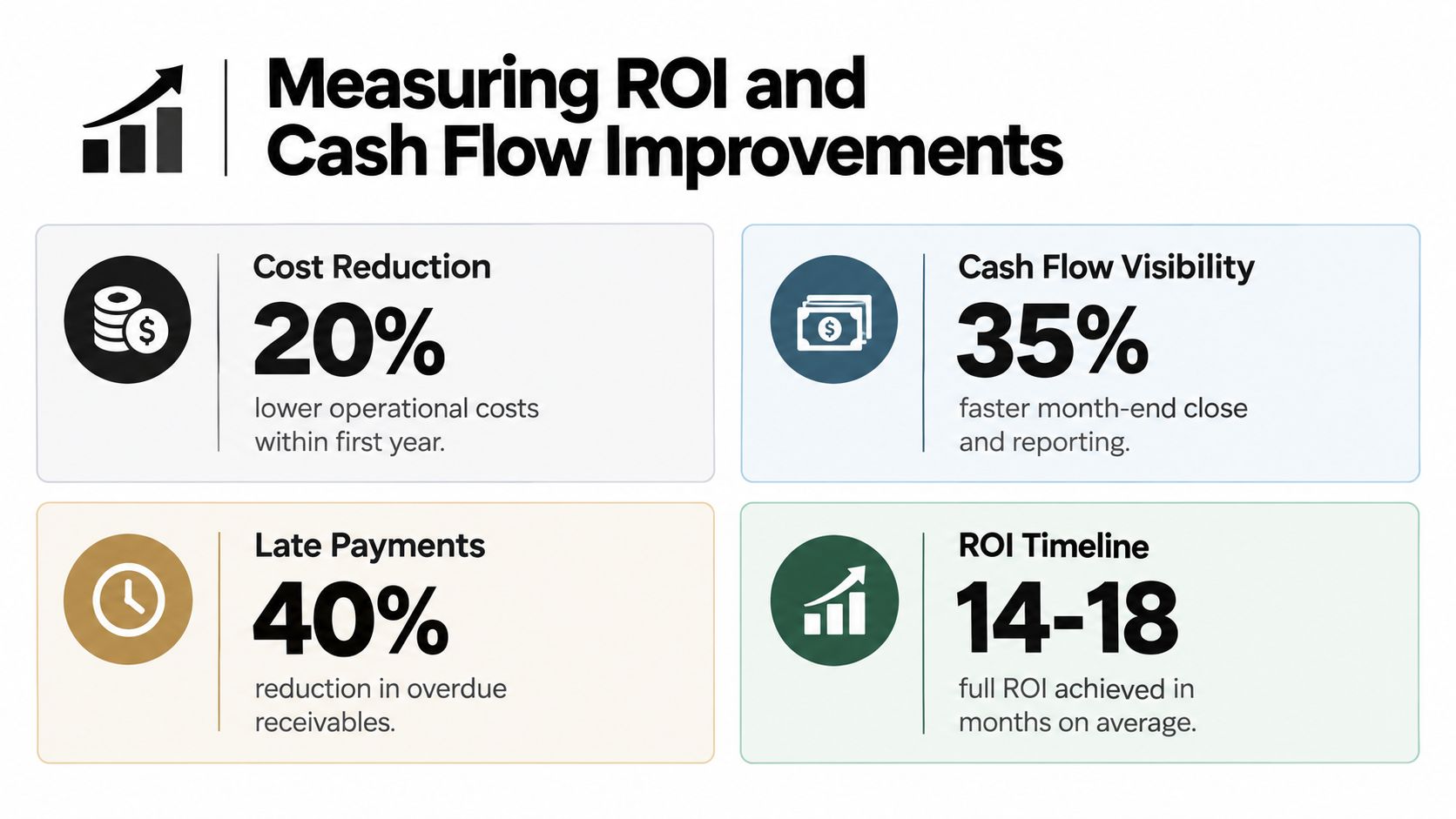
ERP ROI becomes easier to defend when the baseline describes a real finance bottleneck. Invoice processing offers a clear example. A 2024 UK report recorded an average invoice approval cycle of 35.75 hours and an average processing cost of £13.68, while only 23% of UK organisations said they were fully prepared for e-invoicing, according to the UK invoice automation benchmark.
Those figures don't prove that every Odoo project will deliver a fixed saving. They do show why an SME should measure its own invoice volume, approval delay, exception rate, duplicate effort, and payment timing before configuration begins.
Where invoice workflow value comes from
The strongest design doesn't scan a bill. It decides what can be processed safely without intervention and sends only exceptions to a person.
- Three-way matching: Compare the purchase order, receipt, and supplier invoice before posting.
- Approval hierarchies: Route invoices according to spend authority, department, project, or entity.
- Segregation of duties: Prevent one person from creating a supplier, approving a bill, and releasing payment without appropriate controls.
- Exception queues: Give the team a visible list of price variances, missing receipts, tax issues, and duplicate risks.
- Payment visibility: Connect approved liabilities to due dates and cash planning.
Finance ROI connects to working capital. A clean approval workflow can reduce avoidable delay without encouraging premature payment. It can also expose invoices that are blocked because the business has not confirmed receipt, coded the cost, or resolved a purchase-order discrepancy.
A defensible ROI calculation
Start with a baseline that finance can reproduce. Record the current processing cost, approval time, number of manual touches, unreconciled items, and late-payment causes. Then agree which improvements the ERP project is expected to influence and which depend on policy, supplier behaviour, or customer collections.
Track:
- Processing effort, measured through finance time spent per invoice and on exception handling.
- Approval speed, measured from receipt to approval and from approval to payment.
- Working-capital impact, measured through payment timing, overdue receivables, and committed purchasing visibility.
- Reporting effort, measured through time spent reconciling operational and accounting data.
- Adoption, measured by the proportion of transactions following the designed workflow.
A cash forecast should sit beside this analysis, not after it. The practical guidance in this Odoo cash-flow forecasting guide for UK SMEs reflects the point that finance teams need forward-looking information, not merely a cheaper way to post historical transactions.
Navigating UK Compliance and Multi-Entity Reporting
UK compliance should shape the Odoo design from the beginning. Retrofitting VAT logic, statutory reporting, or audit evidence after users have started posting transactions creates avoidable rework and weakens confidence in the ledger.
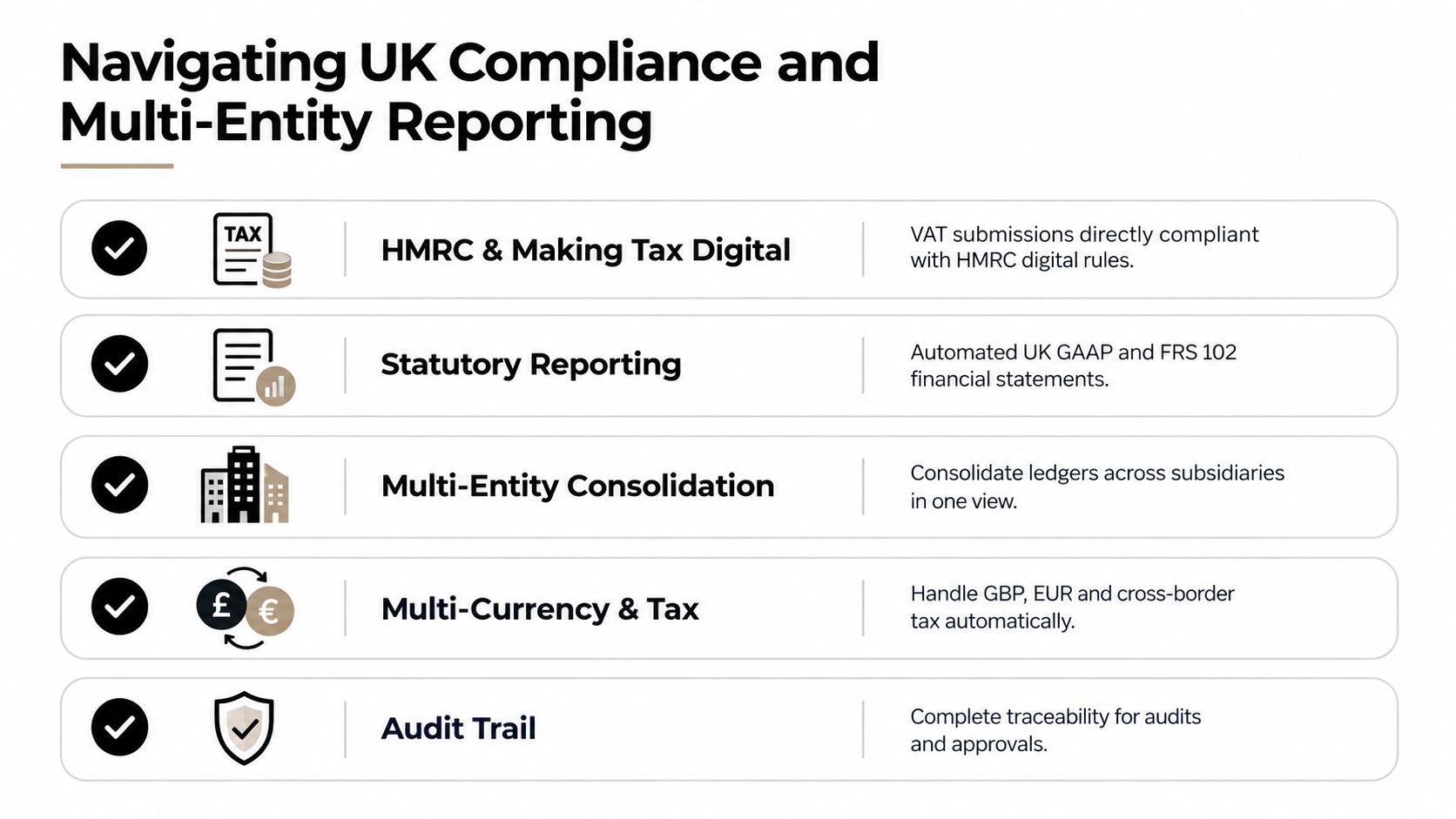
Odoo provides a dedicated UK Accounting package, l10n_uk, and a UK Accounting Reports package, l10n_uk_reports. The accounting package is described as CT600-ready and VAT100-ready, while the reports package supports sending the tax report to HMRC through the MTD-VAT API, as documented in this UK Odoo localisation guide.
Configure VAT before importing transactions
A sensible setup sequence is:
- Select the UK fiscal localisation: Start with the correct accounting and reporting packages.
- Define the VAT scheme: Confirm the business treatment before configuring taxes and journals.
- Map UK tax codes: Align products, purchases, sales, and exemptions with the intended VAT logic.
- Connect HMRC: Establish the OAuth connection required for digital submission.
- Test the return: Reconcile the Odoo output to existing records before the first live filing.
A UK-specific Odoo guide states that Odoo Enterprise is HMRC-recognised for Making Tax Digital and can submit all 9 VAT return boxes directly to HMRC through the API without bridging software. The same source explains the practical use of UK fiscal localisation, VAT scheme selection, tax-code mapping, and OAuth connection in the Odoo and HMRC MTD setup guidance.
Build audit evidence into transactions
Compliance isn't only a tax submission. UK statutory-audit environments require finance teams to explain how controls operate across transactions, configuration, and approvals. The implementation should identify which controls are automated, which require manual review, and which compensating controls apply where automation isn't appropriate.
Protect:
- Journal integrity: Restrict posting rights, document journal sources, and review unusual entries.
- Master-data accuracy: Control supplier bank details, customer terms, tax settings, and account mappings.
- Approval traceability: Retain timestamps, user IDs, workflow logs, and change histories.
- Evidence retrieval: Make supporting records available at the transaction layer rather than reconstructing them from email.
For group structures, consistent chart-of-accounts design, intercompany rules, currency treatment, and entity permissions matter as much as consolidation reports. Finance directors assessing multi-entity accounting tooling should focus on how the platform handles ownership, eliminations, local requirements, and group visibility.
Further guidance on consolidated financial reporting for UK groups is valuable when the reporting model spans subsidiaries or trading entities. A compliant system is one where the numbers and the evidence behind them remain connected.
A Practical Odoo Implementation Roadmap for SMEs
Most SME ERP projects don't stall because the software lacks a button. They stall because the business hasn't agreed how work should flow, who owns the data, or which legacy habits must end.
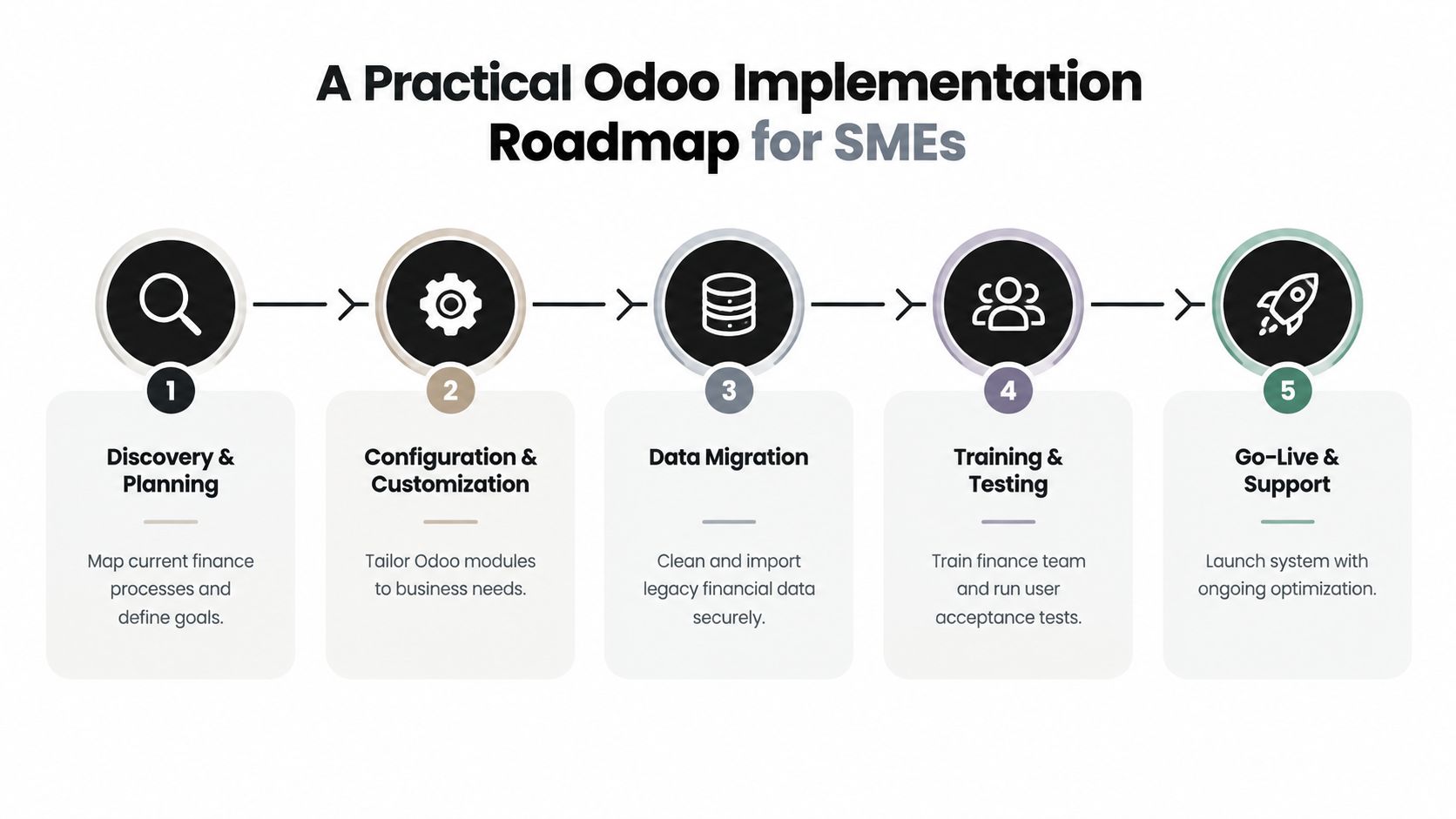
A practical Odoo rollout starts with discovery. Map the current order-to-cash, procure-to-pay, banking, VAT, reporting, and close processes. Include the awkward cases, such as credit notes, partial deliveries, landed costs, intercompany charges, and invoices received without purchase orders.
Five stages that keep scope visible
- Discovery and planning: Define the finance outcomes, document process owners, and agree the reporting and control requirements.
- Configuration and customisation: Configure standard Odoo features first. Customise only where a documented business requirement justifies the additional maintenance.
- Data migration: Clean suppliers, customers, products, tax codes, opening balances, and historical information before import. Poor master data can make a well-configured system look unreliable.
- Training and testing: Use real transaction examples and require finance users to complete user acceptance tests. Training should cover exceptions, not only the happy path.
- Go-live and hypercare: Launch with agreed support routes, daily issue review, and a controlled list of post-launch improvements.
Supplier data deserves particular attention. Duplicate records, incomplete legal details, and unverified tax information can create payment and compliance risks. A specialist resource on TaxID for supplier validation can help shape the validation requirement before migration.
The commercial model should match the delivery method. Fixed-milestone pricing with explicit deliverables and acceptance criteria gives an SME a clearer way to manage scope than an open-ended list of hours, provided the assumptions and exclusions are written down. Direct access to the consultants and developers building the database also shortens the route between a finance issue and a technical decision.
The implementation should prototype with real data before the final migration. That exposes chart-of-accounts gaps, tax mapping problems, reporting conflicts, and approval bottlenecks while the team can still change the design.
A structured Odoo implementation service should leave the finance director with more than a live database. It should provide documented processes, trained users, tested controls, reconciled opening data, and a prioritised improvement backlog.
Avoiding Common Pitfalls and Tracking Success KPIs
ERP adoption doesn't guarantee ERP value. The 2025 CFO Mindset Report found that 80% of UK and Irish finance leaders had adopted ERP for their finance function, while 94% said they regretted implementing ERP systems, according to the CFO Mindset Report coverage. The same report says 60% used half or fewer of the features they purchased, and only 2% used their ERP system to its full potential.
The contrast is stark. Deployment is widespread, but usage depth is poor. That usually points to unsuitable configuration, weak training, unowned processes, or an implementation that treated Odoo as a replacement for the old system rather than a chance to redesign finance operations.
Compare the system you installed with the system you need
| Weak implementation pattern | Finance-led alternative |
|---|---|
| Users rekey sales and purchasing data | Operational transactions feed shared finance records |
| Approvals happen through email | Approval rules create a visible, auditable workflow |
| Reports are rebuilt in spreadsheets | Management reports use agreed dimensions and live source data |
| Exceptions are handled informally | Exceptions have owners, statuses, and resolution dates |
| Every module is activated | Modules are introduced according to a defined business case |
Don't measure success by the number of applications switched on. Measure whether the finance team can answer cash and control questions with less manual reconstruction.
KPIs that show whether the design works
Track the month-end close duration, but don't stop there. Monitor the volume of manual reconciliations, the age and value of unreconciled bank items, invoice approval time, overdue receivables, forecast-versus-actual cash variance, and the percentage of transactions following the intended approval path.
The KPI definitions need owners. Finance should own close and reconciliation measures, procurement should own purchase-order compliance, sales should own billing readiness and collection inputs, and senior management should review cash forecasting quality. A dashboard without accountability becomes another reporting exercise.
Control the exceptions, not just the transactions. Routine processing should become quiet. Management attention belongs on unusual journals, blocked invoices, overdue debts, unexpected stock commitments, and forecast variances.
Review the measures regularly and change the configuration when the business changes. New entities, payment terms, warehouse processes, and product models can all alter the data flow. Continuous improvement is what turns an ERP from an installed application into a dependable finance operating model.
Partnering with ERP Artists for Finance Transformation
Software selection is only one part of the decision. The implementation partner determines how carefully the team maps processes, handles migration, configures controls, integrates operational systems, and supports users after launch.
ERP Artists is a Certified Odoo Partner with 8+ years of implementation experience, a track record of serving 200+ businesses, and 150+ delivered or customised modules, as described in its publisher profile. Its engineering capability includes 15M+ lines of code built to extend Odoo safely, alongside consultancy, custom Python development, API integrations, migration, hosting, training, and support.
That breadth matters when finance requirements cross departmental boundaries. A UK SME may need bank-feed automation, ecommerce or CRM integration, warehouse workflows, custom approval logic, or AI-assisted back-office processes alongside accounting and reporting. A partner that can connect those components can keep the finance design anchored to the underlying business process.
The delivery approach is practical: operational audit, prototyping with real data, migration, training, launch, and hypercare. Fixed milestones with explicit deliverables make acceptance clearer, while direct access to the consultants and developers reduces handover friction.
ERP Artists should still be evaluated against the same criteria as any other partner. Ask for the proposed chart of accounts, VAT configuration approach, migration rules, approval matrix, test scripts, reporting catalogue, support model, and change-control process. The right partner won't promise that Odoo fixes every finance problem automatically. It will show how the system, people, controls, and operating policies fit together.
ERP Artists helps UK SMEs design and implement Odoo for cash-flow visibility, controlled finance workflows, UK compliance, integrations, migration, training, and ongoing support. Visit ERP Artists to discuss your current finance processes and plan an Odoo implementation built around measurable operational outcomes.